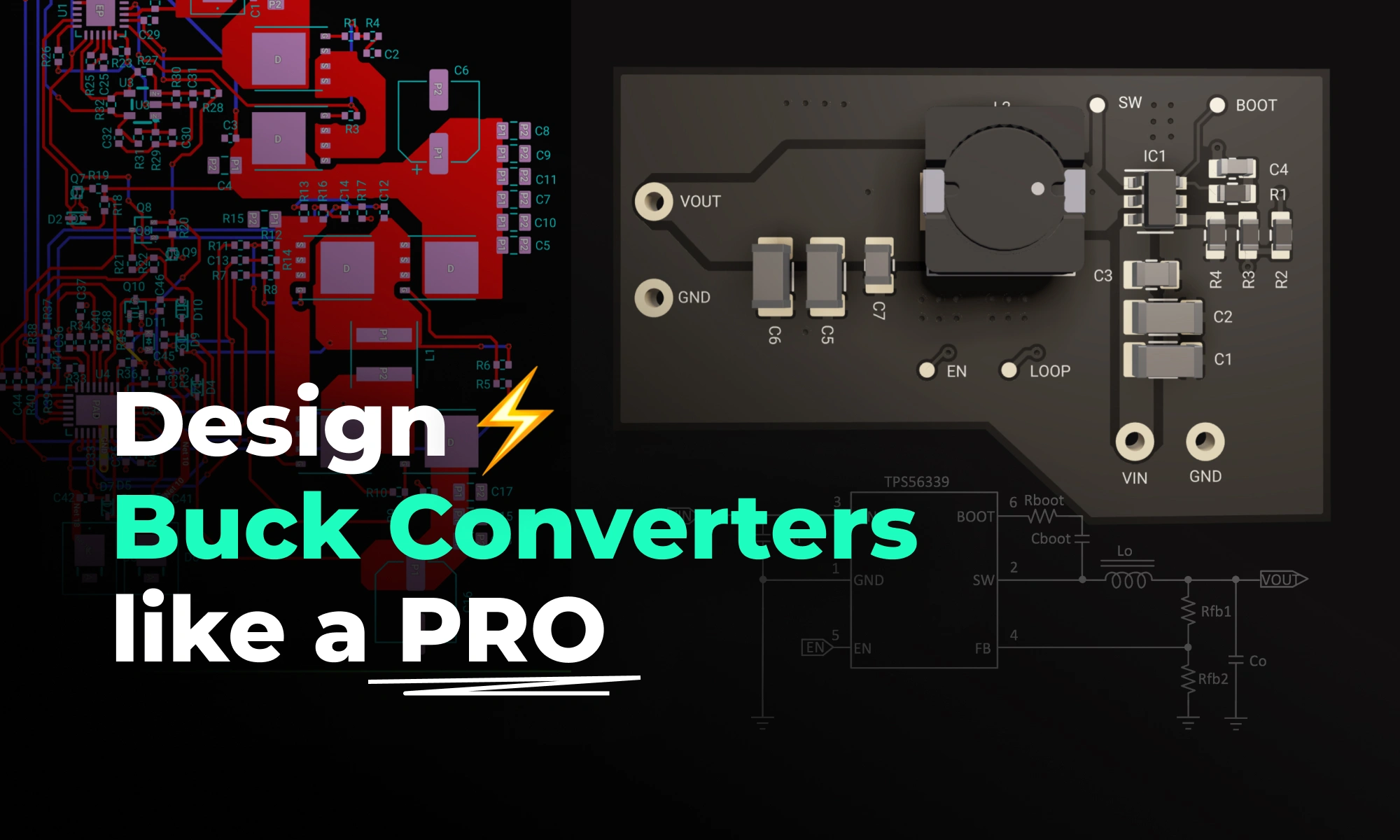
When you’re first diving into power-supply design, buck converters can feel a bit like magic boxes—take a higher voltage in, and out comes a perfectly regulated, lower voltage with impressive efficiency, minimal noise, and a tiny PCB footprint. Yet the true secret to a well designed converter isn’t just hidden in some arcane equation; it’s also the way you lay out copper on your board.
At its heart, a buck converter is nothing more than three core elements working together to regulate a higher voltage to a lower voltage—and understanding these will make everything else click.
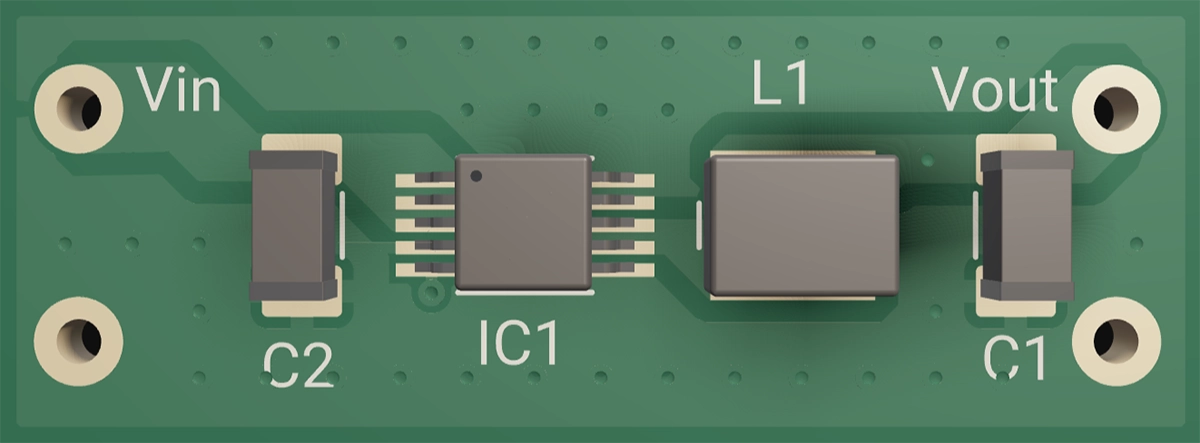
The Fast Switch (MOSFET) This semiconductor turns your input voltage on and off hundreds of thousands—or even millions—of times per second. By varying the duty cycle (the fraction of time “on” versus “off”), it controls the average energy delivered downstream.
The Inductor (“Energy Storage”) During each “on” phase, the inductor stores energy in its magnetic field; when you switch off, that energy discharges into the load. This pulsed exchange smooths out the current and sets the stage for a steady voltage.
The Capacitors (“Voltage Buffers”) Placed at the output (and often at the input), these absorb the inductor’s ripple and deliver bursts of current when your load suddenly demands it. Together, the inductor and capacitors form an LC filter that turns square pulses into a level, and ideally stable, DC voltage rail.
Here’s the simple math for a 12 V→5 V converter:
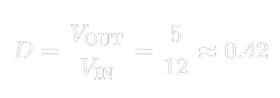
That 42 % duty cycle tells the MOSFET exactly how long to stay on each cycle so the LC filter averages out to 5 V.
Behind the scenes, a control IC monitors the output, compares it to an internal reference, and tweaks that duty cycle in real time to handle changing loads or input swings. But regardless of controller complexity, the switch + inductor + filter always remain the converter’s heart and soul.
Component Selection: Why It Matters (and How to Get It Right)
Pick the wrong inductor, and you may face problems like overheating, excessive output ripple, or even core saturation that starves your load under sudden demand. To help you choose wisely, here’s what every beginner EE should know about inductor characteristics:
Current Rating and Saturation (Isat) Every inductor has a maximum current above which its magnetic core saturates and loses inductance, causing large current surges. Aim for an Isat at least 1.2×–1.5× your peak load to ensure reliable performance under transient conditions.
DC Resistance (DCR) DCR is the winding’s inherent copper resistance. Lower DCR reduces conduction losses and heat buildup—boosting efficiency—but often comes in a larger or costlier package. Balance your efficiency goals with board space and budget constraints by selecting the lowest practical DCR.
Core Material The core defines how the inductor behaves across frequencies and currents:
Ferrite cores are the workhorses of switching converters, offering high permeability and low losses at high frequency. They deliver crisp switching edges and minimal ripple—ideal for most buck designs.
Powdered-Iron cores incorporate distributed gaps, giving a gentler saturation knee and better performance under high DC bias. Use them when your peak currents vary widely or when you need softer saturation behavior.
Shielded vs. Unshielded: Shielded inductors confine magnetic fields within their package, reducing EMI coupling to adjacent traces. Unshielded inductors can be more compact but may require extra clearance from sensitive circuits.
Package & Thermal Performance Inductor packages differ in footprint, height, and thermal dissipation. Compact surface-mount inductors save board space but may run hotter; larger through-hole or tall-stack types handle more power but occupy more real estate. Evaluate your thermal budget and mechanical constraints when selecting package size.
Pro tip:Choosing an inductor with a bit of extra saturation current rating and modestly lower DCR gives you valuable headroom during prototyping—preventing unexpected heat and ripple issues as your load conditions change.
Capacitor Mix
A combination of MLCCs and a bulk cap covers ripple from kHz to MHz—get this wrong, and you’ll hear audible squeals or see output spikes.
Capacitor Selection
| Type | Role | Placement | Pro Tip |
| :--- | :--- | :--- | :--- |
| MLCC | Kill high-frequency ripple | Within 1–2 mm of switch and inductor | Derate by ≥2×—X5R/X7R parts deliver only 40–60 % of marked capacitance under bias |
| Bulk | Reservoir for mid/low-freq. | Beside the output inductor | Watch ripple-current rating; its ESR provides a natural damping zero |
Deep dive: MLCCs lose capacitance under DC bias and heat. And yes, they can sing! Ensure parallel MLCCs are carefully secured mechanically to mute piezo effects. Placing smaller-value capacitors first help to attenuate the high frequency singing in the larger smoothing caps.
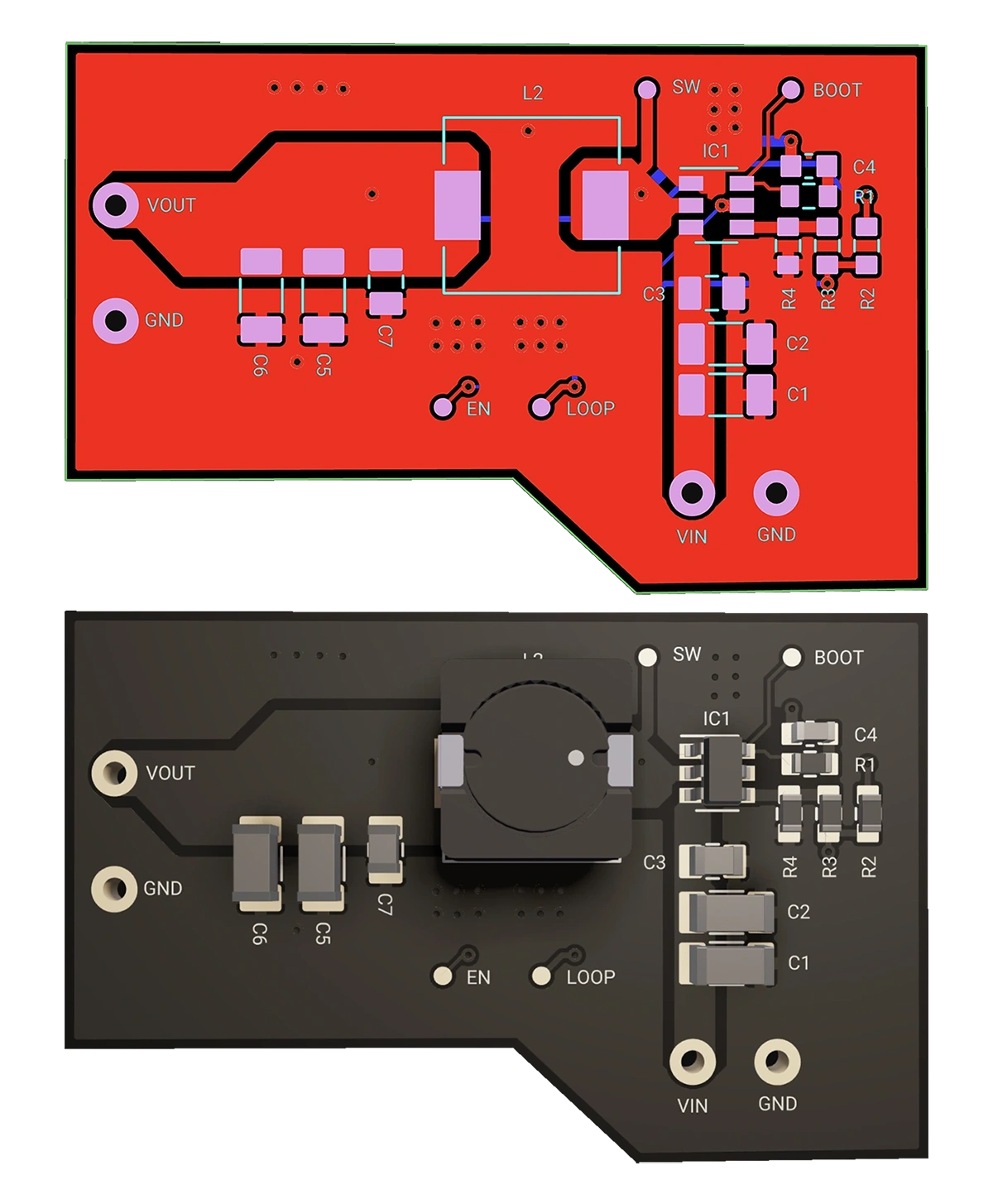
Having chosen your parts, layout is your next battleground. The difference between a noisy, inefficient converter and a clean, reliable one often comes down to copper placement. Follow these steps to keep that switching loop tight and your ground plane unbroken.
Remember: “Keep the switching loop tiny and the ground plane continuous.”
Minimize the Switch Loop
Sketch the loop: Input cap → High-side MOSFET → Inductor → Output cap → Return to input cap.
Goal: Loop area < 10 mm². Every extra mm² adds parasitic inductance, causing ringing, EMI, and wasted switching energy.
Tip: One customer saw a 20 dB EMI drop simply by shrinking their loop from 15 mm² to 8 mm²!
Use at least six short vias per cap or ground polygon. More vias lower impedance, spread heat, and tame high-frequency noise.
Separate Control Signals
Route gate-drive and feedback traces outside high-current loops. If intersections are unavoidable, shield with a small ground pour.
Different Buck Converter Topologies
From full DIY assemblies to one-click, ready-to-use modules, these different topologies trade off flexibility, board space, and time-to-market. Pick the one that fits your project rhythm.
| Topology | What You're Really Building | When to Use it |
| :--- | :--- | :--- |
| Discrete | Hand-select controller, gate driver, MOSFETs, inductor. Like building a bike wheel by wheel | Total flexibility, custom performance, or lowest part cost |
| [DrMOS](https://www.flux.ai/flux/tps62130argtr-regulator?editor=pcb_2d) | Integrated MOSFET + driver in one package—just add inductor and caps. Like buying a pre-built engine. | Mid-power designs, tight PCB area |
| [Power Module](https://www.flux.ai/flux/buck-boost-3p3v-500ma-physical-module) | Complete power stage: driver, MOSFETs, inductor, capacitors, telemetry—even PMBus. Ready-to-ride e-bike | Fastest path to market, highest integration |
Each template already includes polygon pours for power and ground, and via-stitching. Once cloned, customize only what matters.
Ground planes are a default in any Flux project, which reflows around all parts and pads to help with noise isolation. Polygons are now in Flux helping you leverage wide current paths for your output voltage to flow through. Adjust thermal reliefs, keep-outs, and copper weights without redrawing anything.
Stuck on compensation loops or gate-resistor values? Ask Copilot right inside the editor. It explains theory, suggests values, and even pulls tables from datasheet PDFs.
Zone off low-speed signals—UART, I²C, sensors—and let Auto-Layout handle them. That frees you to hand-route the critical buck loops that define performance.
“Copilot help me determine the best orientation of U1 to minimize the switching current loop.”
Quick-Reference Cheat Sheet
Think of this as your design checklist: tape it to your monitor, keep it next to your keyboard, or fold it in your notebook. Pull it up whenever you need a formula, a layout reminder, or a topology refresher.
Key Formulas & Practices
| Topic | Formula / Practice | Why it Matters |
| :--- | :--- | :--- |
| Duty Cycle (D) | D = VOUT / VIN | Sets the average output voltage |
| Inductor Ripple | ΔIL = (VIN–VOUT) · D / (fSW · L) | Balances ripple vs. transient response |
| Efficiency (η) | η = (VOUT · IOUT) / (VIN · IIN) · 100 % | Quantifies total losses |
| Switching Loss (Psw) | Psw = (Eon + Eoff) · fSW | Guides MOSFET choice and frequency |
| SW Loop Area | less than 10 mm²| Minimizes parasitic inductance and EMI |
| Via Stitching | ≥ 6 vias per capacitor | Lowers impedance and spreads heat |
| Grounding | Continuous plane under SW node | Prevents unintended current loops |
Topologies & Control Methods
| Aspect | Options / Methods | When to Use |
| :--- | :--- | :--- |
| Topologies | Discrete / DrMOS / Power Module | Flexibility vs. integration vs. speed to market |
| Control | Voltage-mode, Peak-Current, COT | Trade loop speed, stability, and complexity |
| Gate-Drive Tuning | Rgate: 2–5 Ω; Dead-time: 20–50 ns | Optimize EMI control vs. switching speed |
| Capacitor Mix | MLCC + Bulk (Ta/Poly) | Flat impedance across the frequency spectrum |
Ready to Build Your First Buck in Minutes?
Pick your topology above and click Clone in Flux.
Drag & drop your caps and inductor from the parts panel.
Invoke Copilot for any component or layout question.
Hand-tune your switch loops—and watch your efficiency and EMI metrics soar.
With Flux’s polygons, AI Copilot, and Auto-Layout, you’ll spend less time wrestling nets and more time optimizing your power stage—so you can ship faster and with confidence.
At its heart, a buck converter is nothing more than three core elements working together to regulate a higher voltage to a lower voltage—and understanding these will make everything else click.
The Fast Switch (MOSFET) This semiconductor turns your input voltage on and off hundreds of thousands—or even millions—of times per second. By varying the duty cycle (the fraction of time “on” versus “off”), it controls the average energy delivered downstream.
The Inductor (“Energy Storage”) During each “on” phase, the inductor stores energy in its magnetic field; when you switch off, that energy discharges into the load. This pulsed exchange smooths out the current and sets the stage for a steady voltage.
The Capacitors (“Voltage Buffers”) Placed at the output (and often at the input), these absorb the inductor’s ripple and deliver bursts of current when your load suddenly demands it. Together, the inductor and capacitors form an LC filter that turns square pulses into a level, and ideally stable, DC voltage rail.
Here’s the simple math for a 12 V→5 V converter:
That 42 % duty cycle tells the MOSFET exactly how long to stay on each cycle so the LC filter averages out to 5 V.
Behind the scenes, a control IC monitors the output, compares it to an internal reference, and tweaks that duty cycle in real time to handle changing loads or input swings. But regardless of controller complexity, the switch + inductor + filter always remain the converter’s heart and soul.
Component Selection: Why It Matters (and How to Get It Right)
Pick the wrong inductor, and you may face problems like overheating, excessive output ripple, or even core saturation that starves your load under sudden demand. To help you choose wisely, here’s what every beginner EE should know about inductor characteristics:
Current Rating and Saturation (Isat) Every inductor has a maximum current above which its magnetic core saturates and loses inductance, causing large current surges. Aim for an Isat at least 1.2×–1.5× your peak load to ensure reliable performance under transient conditions.
DC Resistance (DCR) DCR is the winding’s inherent copper resistance. Lower DCR reduces conduction losses and heat buildup—boosting efficiency—but often comes in a larger or costlier package. Balance your efficiency goals with board space and budget constraints by selecting the lowest practical DCR.
Core Material The core defines how the inductor behaves across frequencies and currents:
Ferrite cores are the workhorses of switching converters, offering high permeability and low losses at high frequency. They deliver crisp switching edges and minimal ripple—ideal for most buck designs.
Powdered-Iron cores incorporate distributed gaps, giving a gentler saturation knee and better performance under high DC bias. Use them when your peak currents vary widely or when you need softer saturation behavior.
Shielded vs. Unshielded: Shielded inductors confine magnetic fields within their package, reducing EMI coupling to adjacent traces. Unshielded inductors can be more compact but may require extra clearance from sensitive circuits.
Package & Thermal Performance Inductor packages differ in footprint, height, and thermal dissipation. Compact surface-mount inductors save board space but may run hotter; larger through-hole or tall-stack types handle more power but occupy more real estate. Evaluate your thermal budget and mechanical constraints when selecting package size.
Pro tip:Choosing an inductor with a bit of extra saturation current rating and modestly lower DCR gives you valuable headroom during prototyping—preventing unexpected heat and ripple issues as your load conditions change.
Capacitor Mix
A combination of MLCCs and a bulk cap covers ripple from kHz to MHz—get this wrong, and you’ll hear audible squeals or see output spikes.
Capacitor Selection
| Type | Role | Placement | Pro Tip |
| :--- | :--- | :--- | :--- |
| MLCC | Kill high-frequency ripple | Within 1–2 mm of switch and inductor | Derate by ≥2×—X5R/X7R parts deliver only 40–60 % of marked capacitance under bias |
| Bulk | Reservoir for mid/low-freq. | Beside the output inductor | Watch ripple-current rating; its ESR provides a natural damping zero |
Deep dive: MLCCs lose capacitance under DC bias and heat. And yes, they can sing! Ensure parallel MLCCs are carefully secured mechanically to mute piezo effects. Placing smaller-value capacitors first help to attenuate the high frequency singing in the larger smoothing caps.
Having chosen your parts, layout is your next battleground. The difference between a noisy, inefficient converter and a clean, reliable one often comes down to copper placement. Follow these steps to keep that switching loop tight and your ground plane unbroken.
Remember: “Keep the switching loop tiny and the ground plane continuous.”
Minimize the Switch Loop
Sketch the loop: Input cap → High-side MOSFET → Inductor → Output cap → Return to input cap.
Goal: Loop area < 10 mm². Every extra mm² adds parasitic inductance, causing ringing, EMI, and wasted switching energy.
Tip: One customer saw a 20 dB EMI drop simply by shrinking their loop from 15 mm² to 8 mm²!
Use at least six short vias per cap or ground polygon. More vias lower impedance, spread heat, and tame high-frequency noise.
Separate Control Signals
Route gate-drive and feedback traces outside high-current loops. If intersections are unavoidable, shield with a small ground pour.
Different Buck Converter Topologies
From full DIY assemblies to one-click, ready-to-use modules, these different topologies trade off flexibility, board space, and time-to-market. Pick the one that fits your project rhythm.
| Topology | What You're Really Building | When to Use it |
| :--- | :--- | :--- |
| Discrete | Hand-select controller, gate driver, MOSFETs, inductor. Like building a bike wheel by wheel | Total flexibility, custom performance, or lowest part cost |
| [DrMOS](https://www.flux.ai/flux/tps62130argtr-regulator?editor=pcb_2d) | Integrated MOSFET + driver in one package—just add inductor and caps. Like buying a pre-built engine. | Mid-power designs, tight PCB area |
| [Power Module](https://www.flux.ai/flux/buck-boost-3p3v-500ma-physical-module) | Complete power stage: driver, MOSFETs, inductor, capacitors, telemetry—even PMBus. Ready-to-ride e-bike | Fastest path to market, highest integration |
Each template already includes polygon pours for power and ground, and via-stitching. Once cloned, customize only what matters.
Ground planes are a default in any Flux project, which reflows around all parts and pads to help with noise isolation. Polygons are now in Flux helping you leverage wide current paths for your output voltage to flow through. Adjust thermal reliefs, keep-outs, and copper weights without redrawing anything.
Stuck on compensation loops or gate-resistor values? Ask Copilot right inside the editor. It explains theory, suggests values, and even pulls tables from datasheet PDFs.
Zone off low-speed signals—UART, I²C, sensors—and let Auto-Layout handle them. That frees you to hand-route the critical buck loops that define performance.
“Copilot help me determine the best orientation of U1 to minimize the switching current loop.”
Quick-Reference Cheat Sheet
Think of this as your design checklist: tape it to your monitor, keep it next to your keyboard, or fold it in your notebook. Pull it up whenever you need a formula, a layout reminder, or a topology refresher.
Key Formulas & Practices
| Topic | Formula / Practice | Why it Matters |
| :--- | :--- | :--- |
| Duty Cycle (D) | D = VOUT / VIN | Sets the average output voltage |
| Inductor Ripple | ΔIL = (VIN–VOUT) · D / (fSW · L) | Balances ripple vs. transient response |
| Efficiency (η) | η = (VOUT · IOUT) / (VIN · IIN) · 100 % | Quantifies total losses |
| Switching Loss (Psw) | Psw = (Eon + Eoff) · fSW | Guides MOSFET choice and frequency |
| SW Loop Area | less than 10 mm²| Minimizes parasitic inductance and EMI |
| Via Stitching | ≥ 6 vias per capacitor | Lowers impedance and spreads heat |
| Grounding | Continuous plane under SW node | Prevents unintended current loops |
Topologies & Control Methods
| Aspect | Options / Methods | When to Use |
| :--- | :--- | :--- |
| Topologies | Discrete / DrMOS / Power Module | Flexibility vs. integration vs. speed to market |
| Control | Voltage-mode, Peak-Current, COT | Trade loop speed, stability, and complexity |
| Gate-Drive Tuning | Rgate: 2–5 Ω; Dead-time: 20–50 ns | Optimize EMI control vs. switching speed |
| Capacitor Mix | MLCC + Bulk (Ta/Poly) | Flat impedance across the frequency spectrum |
Ready to Build Your First Buck in Minutes?
Pick your topology above and click Clone in Flux.
Drag & drop your caps and inductor from the parts panel.
Invoke Copilot for any component or layout question.
Hand-tune your switch loops—and watch your efficiency and EMI metrics soar.
With Flux’s polygons, AI Copilot, and Auto-Layout, you’ll spend less time wrestling nets and more time optimizing your power stage—so you can ship faster and with confidence.
Ryan is an electronics and electrical systems engineer with a focus on bridging the gap between deep learning intelligent algorithms and innovative hardware design. Find him on Flux @ryanf
Go 10x faster from idea to PCB
Work with Flux like an engineering intern—automating the grunt work, learning your standards, explaining its decisions, and checking in for feedback at key moments.
Discover our latest schematic design updates that streamline wire adjustments, component alignment, and intuitive pin connections, making your design process faster and meeting your high standards for precision. These enhancements, coupled with our AI design assistant, ensure a solid foundation for your projects.
Learn how smart vias in Flux automates the selection, placement, and configuration of vias during the PCB design process. This automation reduces the manual effort involved in via placement and significantly lowers the risk of misalignment and other common errors associated with traditional via management.

In this blog post, we explore how Flux.ai effectively uses Web Workers and ImmerJS to enhance data replication in our web-based EDA tool. We discuss our challenges with data transfer, our exploration of SharedArrayBuffer, and our ultimate solution using ImmerJS patches.
Discover how CAD Librarians can leverage Flux’s key capabilities—AI Part Imports, Component Updates, Live Pricing, and JEP30 Export—each tailored to meet the specific demands of maintaining PCB libraries.
This blog post highlights a series of innovative reference designs developed by renowned manufacturers using Flux. These reference designs encompass a variety of applications, including advanced light sensing, robust data communication, and compact distance measurement. This diverse array showcases the adaptability and effectiveness of Flux in meeting the varied needs of industrial sensing applications
A comprehensive guide to using solder flux in electronics soldering. Soldering flux is used to clean and prepare the surfaces of the components that need to be joined. It helps to remove oxidation and other contaminants that can prevent a strong bond from forming. Flux also reduces surface tension, allowing the solder to flow more easily and improves the wetting of the components.
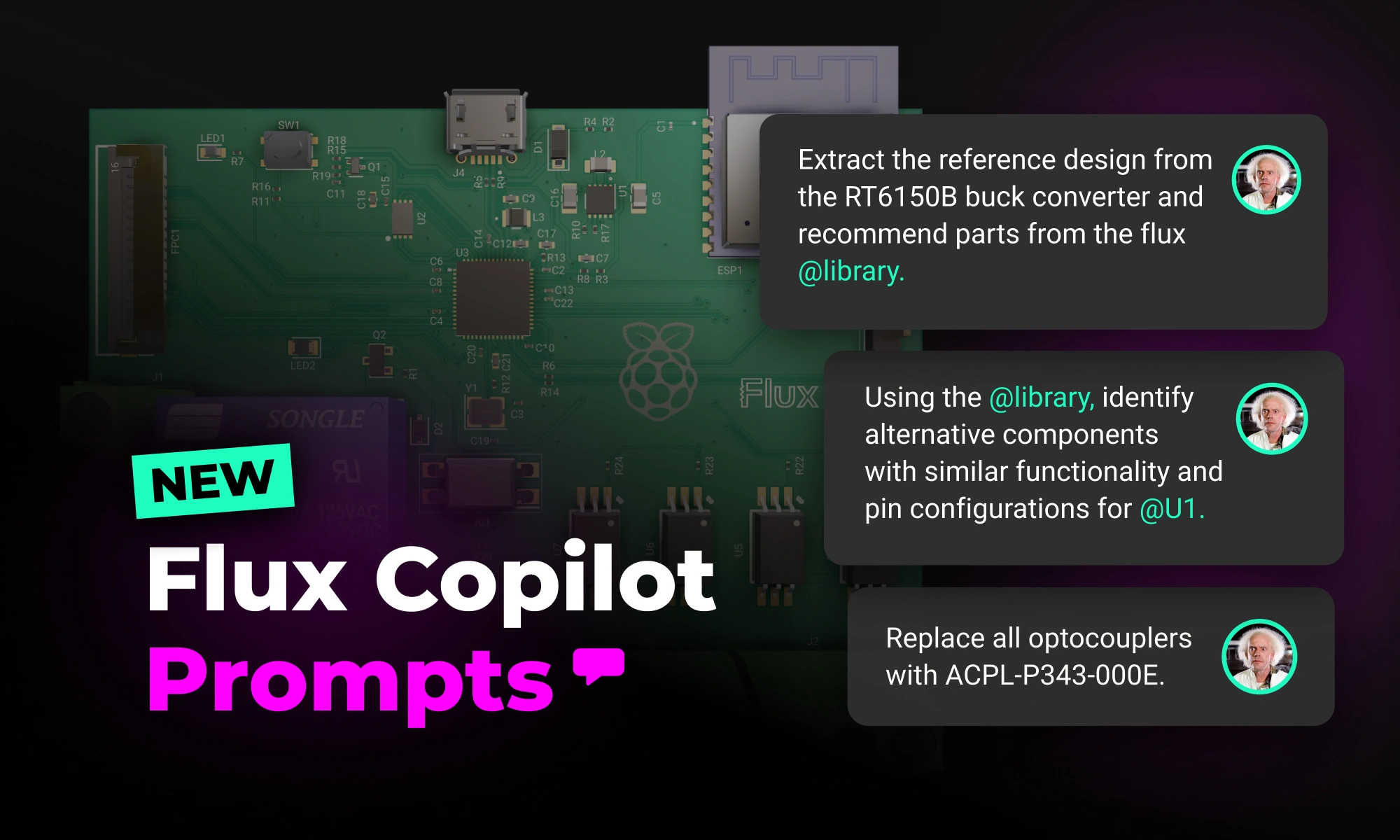
With the latest release of Copilot it isn’t just smarter—it’s hands-on, placing components and applying bulk changes to your project instantly. But to get the most out of it, knowing how to craft the right prompt is key.
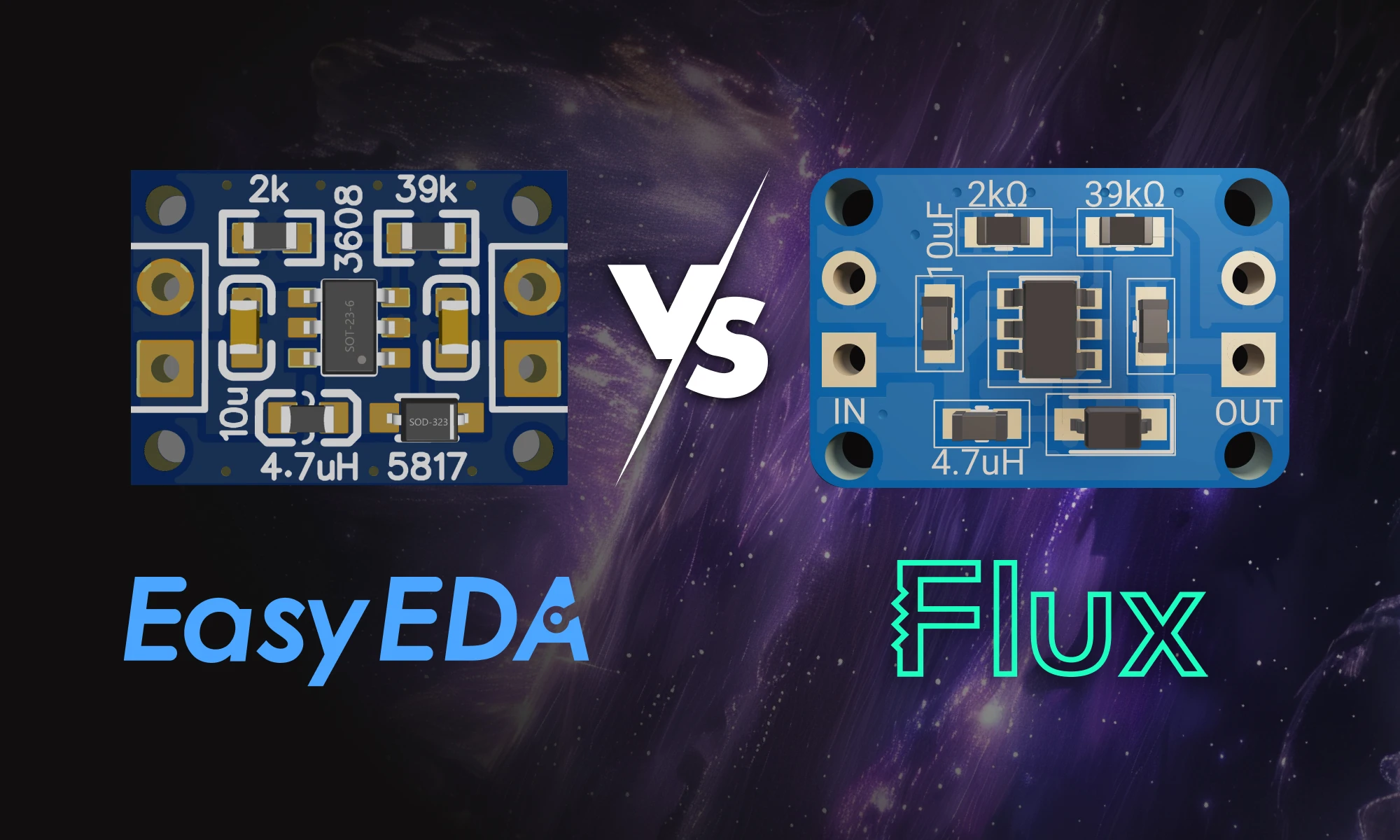
If you’re using EasyEDA and are thinking of making the switch to Flux, learn how the two platforms differ and why Flux might be the next step in elevating your PCB design experience.
One of the key components of PCBs are vias, which are tiny pathways that allow electrical signals to travel from one layer of the board to another. Vias are a staple of PCB design.
The blog post dives into the technical aspects of Multilayer Ceramic Capacitors (MLCCs), highlighting their importance in electronic circuits. It explains the construction of MLCCs, where layers of ceramic material and metal electrodes create a multilayered structure to store electrical energy.
Effortlessly calculate parallel and series resistor values with our accurate, user-friendly tool designed to optimize circuit performance and streamline electrical design processes.
Electronics, whether in a phone or an industrial motor, face potential threats from unchecked electrical currents. Our guide introduces protection circuits, the essential safeguards that monitor and respond to such electrical anomalies.